Wednesday, 7 November 2018

Dinner Diary - Partridge Baked in Pastry, Spiced Pumpkin

Wrapping a whole bird in pastry isn't new, but its something I think we should explore more. Whether its a short paste, puff paste or even a dumpling dough, this is something with a great and illustrious history - everything from batter puddings through to the decadent Cailles en Sarcophages of Babettes Feast, they're always exceptional dishes.


A while ago when we had a friend visiting with her kids I wanted to cook something that children would think 'wow thats amazing' but a parent might still get a kick out of, so I baked a whole chicken wrapped in pastry. Not a weekday dinner though, so today I did something rather more sensible. 

If you follow this blog you know I picked up a pile of partridges in Ely recently, and that I made extra pastry on Saturday. 

This evening I rolled out some pastry to, well, about the diameter of a small dinner plate, egged around the edges and put a partridge (seasoned with a few slivers of horse mushroom and some butter in it) in the middle before sealing it up. I did one bird each. Its a good idea to put them back in the fridge for a while to firm up the pastry before putting them into a hot oven.

Now while the oven was heating up I rubbed spices (coriander, cinnamon, paprika, salt and pepper) onto quarter of a pumpkin and put that into the oven. After that had 15 minutes or so, I put the partridges in. When they came out they looked something like this...


The pastry wrapped birds just needed a little rest, which is great because that gives lots of time to prepare everything else. While my other half washed some cauliflower and put it on to steam, I scraped the pumpkin out into the pan it was roasted in, added a little butter and lemon juice, and mashed it up. And thats it - a show-stopping dinner, and really easy. 

Monday, 5 November 2018

Dinner Diary - PIE DAY!

Was going to be out at a friends monthly D&D game on Sunday which means making and taking some food. And for food on the go, nothing is really better than pie.


I'd say I'm not one to blow my own trumpet but thats a flat out lie. I make kick ass pastry, in a wide variety of recipes, but very often the simplest is best. One pastry, many pies, thats hard to beat. So this was a simple shortcrust - 400g of butter, 800g of flour, a half a teaspoon of salt, beaten with the K beater of a Kenwood chef until it was like breadcrumbs (or cut the butter up and rub it through your fingertips - won't take that long). Thats enough pastry for about four good sized (plate) pies, or, as I was planning, two pies with more pastry in the fridge for week ahead. Once you've got crumbs, keep adding cold water with one hand while working it with the other until you've got pastry. Take it out of the bowl onto a floured board, kneed for a few minutes, and then put it back in a bowl, put a teatowel over it, and put it in the fridge for an hour or two.

Resting your pastry helps so much - it'll work more easily and roll out better. After resting it, I buttered two plates (dinner plates with a good sized rim) rolled a glob of pastry out thin (a little over 1/8 of an inch) and cut it to size. Then its time to fill your pie.

I had a pack of pigeon breasts to used up, and a fridge full of wild mushrooms. So in go the breasts, then salt and pepper and the shrooms, then an egg wash on the outer edge and more pastry on top...


But what about blind baking? What about keeping the crust stiff? I'm glad you asked. Now get all that Bake Off bollocks out of your head, this is real food. Look, the shrooms there will shrink below the pastry, but not before the pastry has set when you put it into a hot-ish oven. So you're left with a lovely crisp top with a gorgeous pastry bottom thats set and firm underneath but soft where it meets the meat. Thats what happens when you butter use butter on the plate and butter in the pastry. 

Anyway, egg wash the top, crimp all round the side with a fork (savoury pies get a fork crimp) and importantly put a few fork holes in the top to let steam out, and you're ready to bake.

The other pie was apple - in go sliced cooking apples, a good hefty sprinkling of sugar and some cinnamon.

Tap it on the bench to sink the sugar and cinnamon in, and then top it as for the pigeon pie (egg round the edge, pastry, egg glaze) but crimp around it with your thumbs. This is a sweet pie, thats what you do. Thumb. Not fork crimp. And put a hole in the top for steam, and you'll get a good crust again.

Bung it in the oven at 200C for 10 minutes, then turn it down to 170C for about half an hour, maybe longer - until when you stick a skewer in its all hot through. And put it aside to cook - it will be delicious.

Pigeon and mushroom pie cooked this way gives a subtle mushroom flavour all through the pigeon, with a rich musoroomy layer on top. Look how the pastry is crisp and the innards of the pie moist and lovely.


And the apple pie is, well, an apple pie with lots of cinnamon. Its an all round champion of a pie, as apple pie always is.


Now this plate pie principle is pretty much universal. You can put in mince and onion (add a little splash of water and a teaspoon of flour), chicken and mushroom, or mince and potato, bacon and egg (literally chopped bacon and beaten egg, its great), sausage meat, quince and apple, blackberry and apple, quite literally nearly anything. Sliced veg and just a little white sauce is good. The basic principle of a thick plate pie is the simplest kind of baking you an imagine, and is pretty much always a winner. And its great game night food.


Saturday, 3 November 2018

Dinner Diary - Pigeon Breast and Mixed Up Mash

Pigeon is the tastiest meat you can get. Its more or less perfect - rich, moist, low fat, easy to cook fast and serve red or you cook it slowly and it holds its form. And best of all, it is delicious and cheap. Stewing whole birds on the bone is great but, often, just using the breasts is better.


I had a whole pack of a dozen breasts from Radmore Farm Shop in Cambridge and I was making pigeon and wild mushroom pie for tomorrow (more of that to follow!), so I put four breasts aside for dinner.

Now, you can't just eat meat of course. So I sliced up pumpkin, potato and celeriac and put them into a dish in the microwave. While they were cooking I seasoned the pigeon breasts with lots of salt and pepper and cooked them in a hot frying pan with just a splash of oil, until they were good and browned on the outside and still red in the middle. While they were resting, that gave me time to add a splash of wine to the pan, a little cream, and the smallest dash of soy sauce (thats a secret, don't tell anyone) to make a sauce.

The pumpkin, celeriac and potato were mashed with lots of pepper and some butter, and the pigeon sliced and put on top with the sauce, and a big pile of cabbage to finish off the dish.

Wholesome and utterly delicious, I can't begin to describe how good pigeon is cooked this way. And yes, I'm going on, but pigeon is almost the perfect meat. Its cheap, delicious (shot as a pest for pities sake), low fat and more or less the most versatile meat there is. And with the mixed mash being rich, sweet and filling, this was the perfect dish for a cooler evening.

Thursday, 1 November 2018

Dinner Diary - Ham and Pease Pudding Stottie

I knew we were going to have a couple of days when we'd be dashing out this week, but I had just the right thing in the freezer. The lads at Art of Meat, our local butcher thats well worth a visit, sold me some ham hocks a while ago. So I got one of them out, let it defrost, soaked it to get the excess salt out (put it in a tub, put water on, left it overnight) and then pressure cooked it (half covered it in water, heated the pressure cooker at full pressure for 40 minutes, and left it to cool). Its one of the cheapest cuts you can get and its thoroughly delicious. 


Even better is the stock. It will have set, so warm it up to melt it, take out the meat and put it aside, pour the stock off to cool. The fat will float up and be easy to remove when it sets again.

Now, the stottie. This is Geordie bread and its dead easy - make a simple white bread dough, let it rest once, roll it out thin-ish (like a bit under an inch), prick it all over with a fork and put to thumb marks in the middle. Then bake it in a hot oven for 14 minutes - and thats it. Don't prove the loaf once you've rolled it out. Its dense and tasty. I always reckon on getting two stotties from about the same amount of dough as you make for a loaf of bread.


Pease pudding is made from yellow split peas, the ham stock without fat, and one peeled onion. I'd give you quantities but I've no idea, its all done by eyeball, you'll have to google that. But it all goes into the pressure cooker, cooks on full for 20 minutes, then allow it to cool down until you can open it. Then blitz it up with a hand blender, and let it set. You've got Geordie pate, right there.


I can't tell you how much I love this stuff. Its rich, its salty, its smooth. And you can do a lot with it - straight into sandwiches, as a vegetable side dish with a dinner, or add some water and more veg and cook it into a thick pea soup. Its useful and tasty, its worth making a batch and keeping some in the freezer.

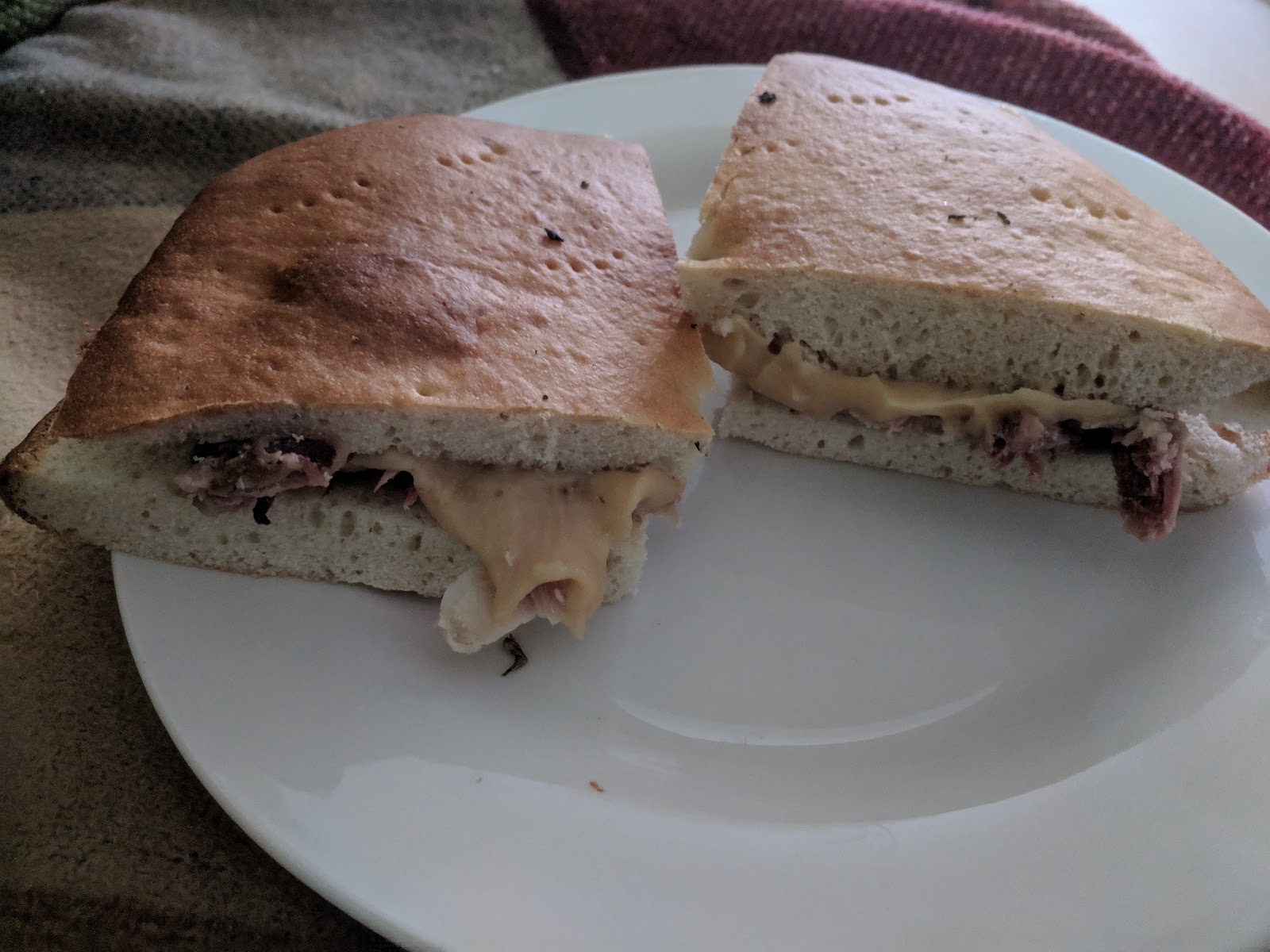
And then the combination... Split a stottie, smear pease pudding on one half, drop ham all over it, and make your sandwich. If you want, you can add some ketchup, chutney or brown sauce, they all work. Or if you're feeling especially decadant, a portion of chips. But whatever you put on it, after eating half a ham and pease pudding stottie you're not going to be hungry. 


Wednesday, 31 October 2018

Dinner Diary - Wild Mushroom Bake

One of the things that differentiates how a forager cooks from how a chef does is the use of mushrooms. For us, its often the case that wild mushrooms aren't a luxury to be used in small volume for flavour or appearance, they're a bulk filler for other food.

How often have you seen some posh restaurant or television chef cook a mushroom dish and make sure all of the mushrooms are somehow visible? Its so often about display, about the expensive ingredient you're paying through the nose for, so you can see it and so those dining with you can see how much you're adding to the bill they're not looking forward to splitting with you. Its about display. But if you pick your own wild mushrooms you probably use them in much greater bulk, for flavour and texture. Yeah, I could have think slices of pretty mushroom on top of a dish - but who am I trying to impress? They're free, growing in a field. Why would anyone be impressed?

This dish really does exemplify the difference in attitude between a forager and a posh chef.


First, you've got to pick your mushrooms. This time I used horse, field and shaggy parasol mushrooms. I could pretend they were selected for the combination of almondy and mushroomy flavours and for the mix of soft and firmer textures, but I'd be lying.  I used them because I had a lot of them, I found a field full of mushrooms yesterday and the day before a patch under some trees covered with parasols. The trick to this dish is to cook the mushrooms first so they retain a better texture. Pack a pan load of mushrooms, drizzle some olive oil, salt and pepper on and put it in a hot oven for 20 minutes or so. While you're doing that wash and slice some potatoes, almost cover them in a pan with milk and simmer it. While thats happening the mushrooms should be ready to come out, they should have reduced in volume rather and they'll have a lovely smell and intensified flavour. 

Another optional step at this stage is to sautee some onion, carrot, celery and bacon in another pan ready to go into the sauce. You don't need this, but if you want to use the bacon as seasoning its a nice touch. Or if you want to keep the whole thing veggie leave out the bacon. I quite like this classic combination of stock vegetables. Somehow it makes this kind of dish more homely, more rounded. Less cheffy and more 'real' if that makes sense. Now, you've got your sauteed vegetables, pan of soft potatoes in milk, and your mushrooms. Its time to make your sauce. 
You all know how to make a white sauce, right? Take your musnrooms out of the skillet, put them aside. Put some butter in, melt it over a low heat and cook for just a minute or so before adding the milk you used for the spuds, slowly at first, stirring all the time to get rid of lumps. You can add some cream at this point if you really want it to be rich, but you don't need to. When the flour is cooked out, toss in a handfull of chopped parsley (if you have some) its time to assemble everything and put it in the oven.

Put a layer of about half of your spuds in the bottom of a casserole dish or big pan and season them. Put the sauteed veg (if you're including them) and mushrooms on top. Then put the rest of the spuds on, and pour the sauce on top. Now you can go and make your topping - drop a chunk of stale bread in the food processor or grate it, and make a bowl of breadcrumbs (always save some stale bread for crumbing). Put alternate layers of bread crumbs and grated cheese on top, with a final layer of cheese and a few knobs of butter at the end. You'll have something like this...


That goes into a hot oven for about 20 minutes, or until its crisp and browned. Dish it out piping hot with salad or whatever side vegetables you want, but I like something green with it.

This is another of those dishes thats more of a technique than a recipe. There's a thousand and one ways you can think of spuds, white sauce and a breadcrumb topping - you could put ham or chicken in it, you could have a layer of broccoli in the middle instead of mushrooms and cook it with a cheese sauce instead of a white one. Bluntly if its spuds, white sauce and cheesy breadcrumbs with something else in it, its likely to be delicious. But this is a really good way of using mushrooms, they're kind of meaty and intense in this dish, and you can really mix things up by using different kinds of mushroom. 

And best of all? This is cheap, substantial and filling. You won't be leaving the dinner table hungry. Enjoy.

Tuesday, 30 October 2018

Dinner Diary - The Inevitable Rabbit and Pumpkin Mulligatawny

So on Sunday things got weird when I roasted a whole pumpkin with a rabbit curry in it. That was absolutely delicious but rather more food that you need for one meal, so on Monday the remains were stripped off into a pan to make soup. It made a really nice and basically almost free dinner for a week day.


So the rabbit stripped from the bones, the curry sauce with mushrooms, nuts, raisins and everything else tipped in, and the pumpkin skinned (the skin comes off easily after baking) and crudely crushed in the hand and tipped into a stock pot. 


All you need to do then is add some stock (I cheated and used a chicken stock cube), some more spice (whatever you want - I added some ground coriander and some garam masala mix), boil it for a while, check the seasoning (I needed to add a little more salt and some lemon juice) and thats it. A fast, easy and ridiculously substantial week-day dinner. Is it a real mulligatawny? I have no idea, the original version of the dish is, I'm sure, delicious, but its something that has become so Anglicised and adapted over almost two centuries that it kind of doesn't matter. I do know that whenever you end up with too much curry, if it was good to begin with, you can probably turn it into a soup the next day.

Dinner Diary - Hot and Sour Dogfish Soup

I had a chat with the fishmonger in Ely on Saturday when I saw this. He said it was huss, until I gave him an inquisitive look. Then he said it was rock salmon. So I asked if he really meant spotted dogfish, and he smiled and said yes. Then he sold it to me good and cheap.


Huss is way too rare to eat. Its a beautiful little shark, and quite delicious but it gives birth to live young and doesn't breed fast at all. So don't eat it. Spotted dogfish are smaller and plentiful - and every bit as tasty. But it really does need to be very fresh - give it a sniff and make sure there's not the slightest whiff of anything resembling ammonia. 

You've got a few bits of cartilage sticking in to the meat but really just the one bit to cut out down the middle - other than that its meaty and boneless.

I selected this because I had a pan of fish stock to use up, the remnants of a gurnard were in the pressure cooker, cooked in water at high pressure to make the stock sterile but still, it needed using up. Into the strained stock went spring onions, soy sauce, thai seven spice mix (inauthentic I know but trust me) lime juice and zest, rice wine, red chili and lots of grated ginger, a splash of rice vinegar, and that was boiled while I cut up the dogfish. I also put a pile of wild mushrooms into the soup because, well, its autumn and I've got a lot of mushrooms to use. While that was cooking I also put some noodles on to cook.

The fish (sliced thin) went into some beaten egg and into a hot pan. Once browned on both sides its basically done. The rest of the egg, I pitched into the soup and stirred in.


And then its simple - noodles go into a bowl, then the soup, and then some dogfish pieces on top, and you're done. 


The principle of this kind of soup is really simple and you can make a whole family of dishes like it, either for a lunch or dinner. As long as you've got some decent stock, you've got the basis of a great soup. And with the nights drawing in, I do like something good and spicy like this.